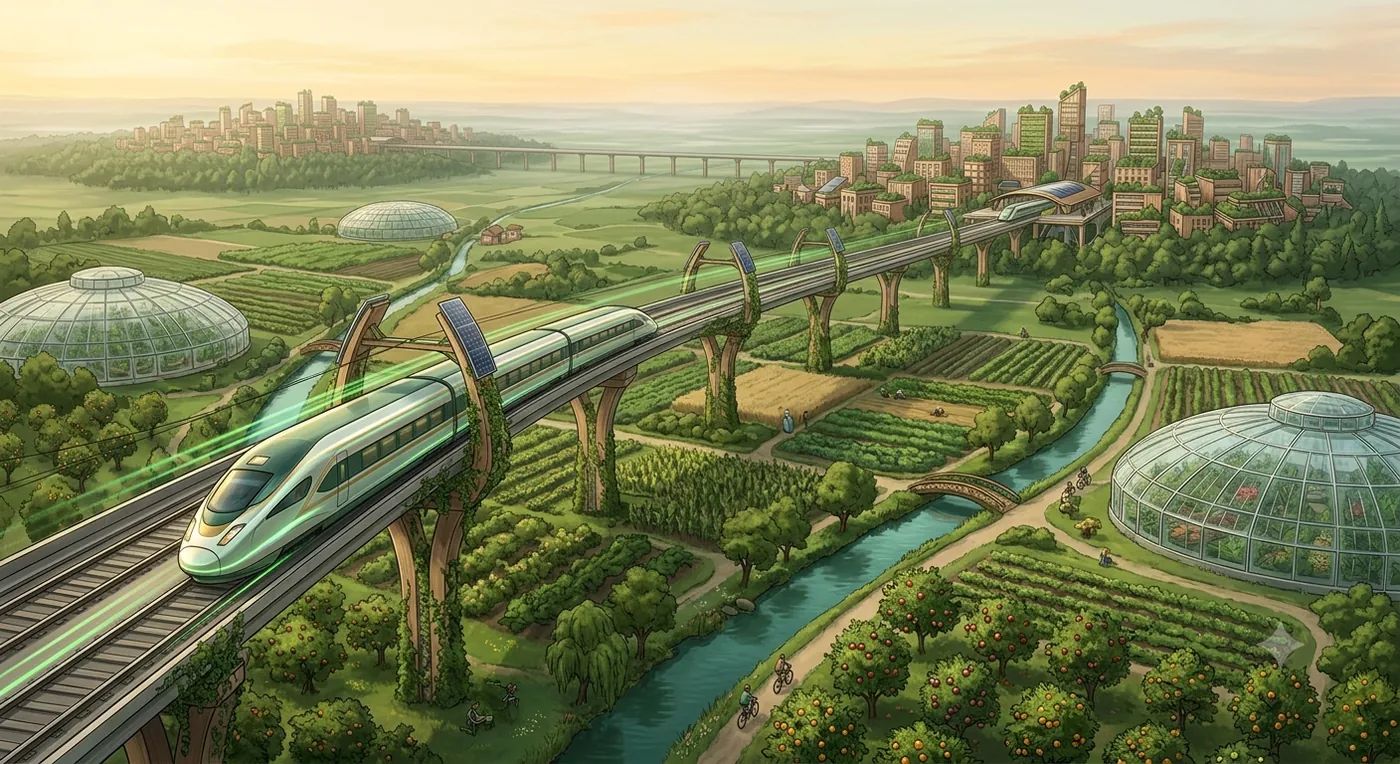
Why inflate one city to an unlivable size when you can simply build another next to it? Several equal cities, together a region, each with a face of its own.
Polycentric at every level: as hamlets together form a city, cities together form a network. They sit like beads on a string, separated by greenery and farmland so they never fuse into one endless sprawl. That solves the question of scale on the spot. No single city ever has to grow past livability.
There is no capital. Every city is equal, in line with the idea that nowhere in this place is there a boss, from hamlet to network. Each city may specialise in what it does well. That gives every city its own identity and makes the cities depend on one another, like organs of one body: equal in importance, different in function.
But specialisation is the icing, not the cake. Every city covers its own essentials first: food, energy, water. That keeps the interdependence a choice rather than a necessity, and keeps the network robust even when a line falters or a city goes down.
The line turns separate cities into one organism while each keeps its own face, the way the monorail welds Walt Disney World's scattered resorts into one world. In every city the line rides into the centre and ends in the crown, the heart of the city, where you switch to the local pods. And because your credits are valid across the network, everything you have built up simply travels with you when you move to another city.
The cities sit close enough for daily life: the fast line itself never takes long, and door to door you travel some thirty to forty-five minutes, depending on where you live. The network is one region and one labour market. Live in one city, work in another.
And when the cities fill up? You do not close the gate, you add a bead to the string. Growth is the answer to popularity. Governance stays light: a council with equal representation per city and a rotating chair, only for what is truly shared, such as the line and the joint emergency fund.
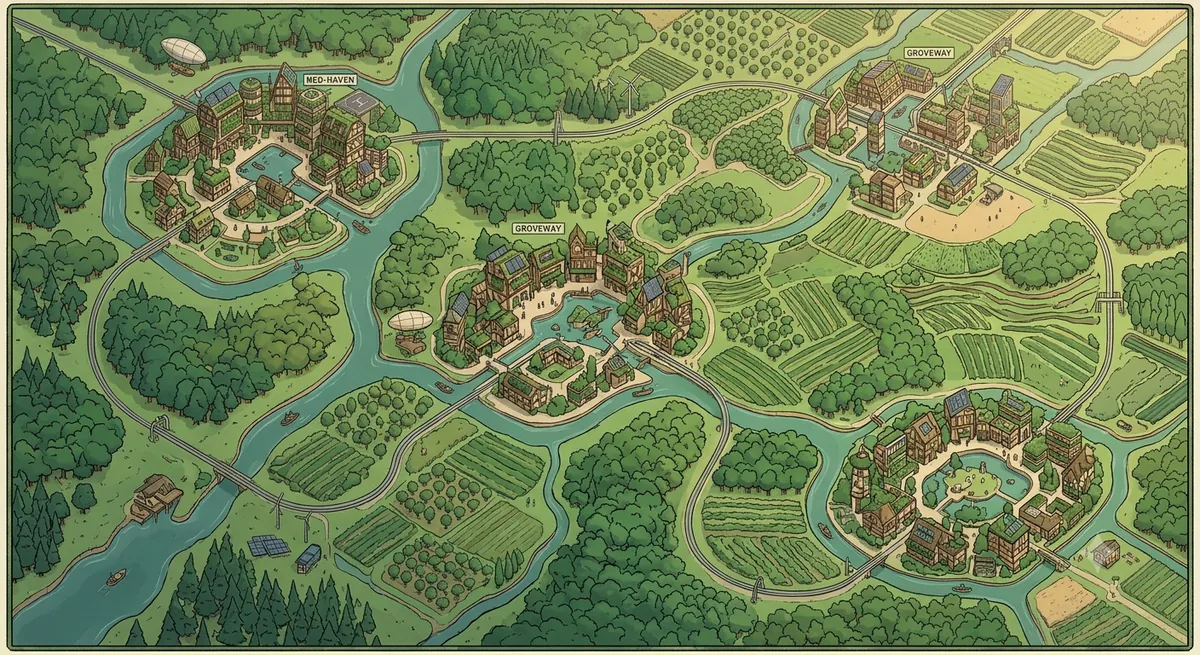
This idea is not new. As early as 1898, Ebenezer Howard sketched not one garden city but a cluster of them, joined by fast transport and separated by landscape. He called it the Social City. Where later dreams such as Walt Disney's EPCOT ran aground on a company owning everything, and where Star Trek never explains who gets the finest spot, this city fills exactly those gaps: ownership, democracy, and a fair way to divide what is scarce. The form is old, the soul we build ourselves.
The idea stands in a long tradition, from Howard to EPCOT to Star Trek. Read what we adopt and what we deliberately do differently.
To Inspiration & lessons