Future Cities
NL
Moving around

The bicycle wins, every time

Every scale has its own transport: walking and cycling in the neighbourhood, pods within the city, a high-speed line between the cities. Nested and consistent, each mode sized to its distance.

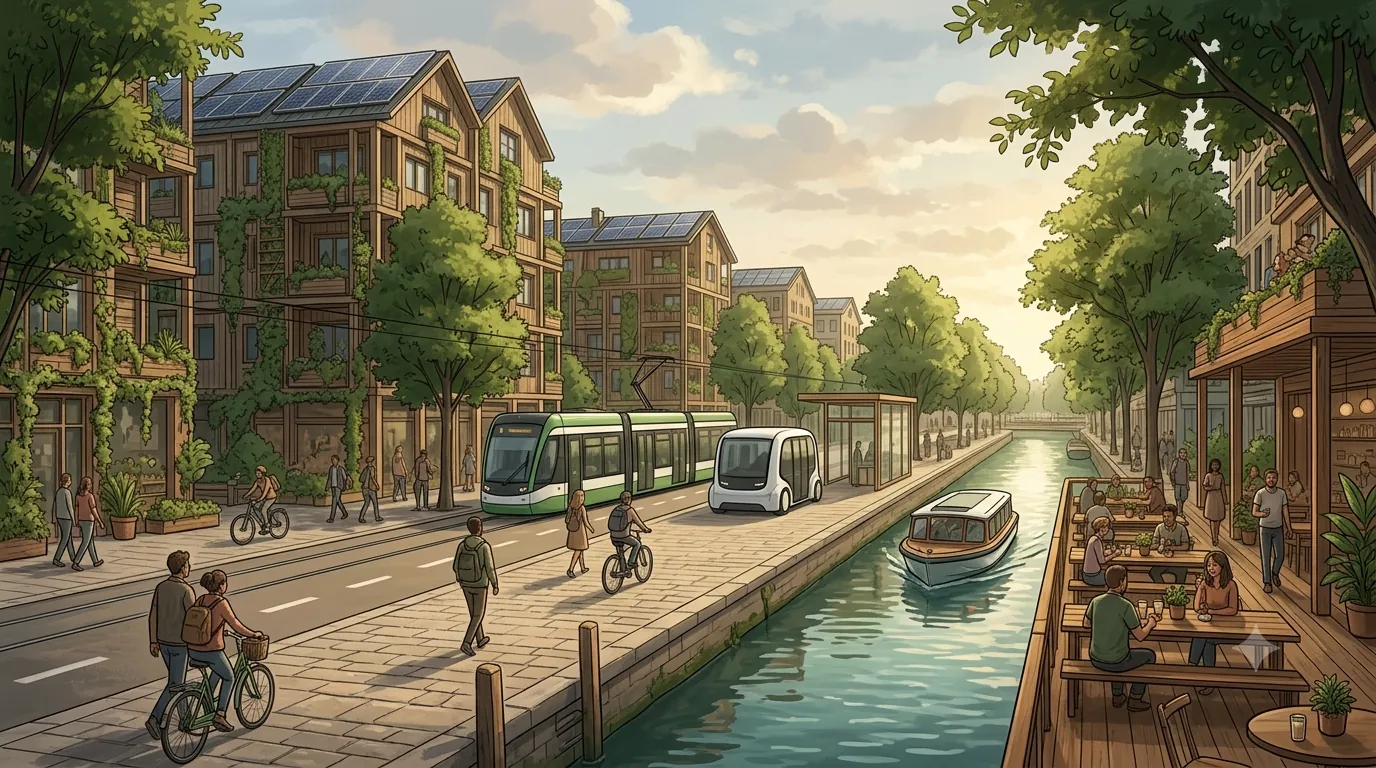
Car-light canal with cyclists and a pod
The nested scale

Three layers that fit together

🚲

In the neighbourhood

Walking and cycling. The bicycle is deliberately made unbeatable: the most direct routes, its own bridges over the water, priority at every crossing.

🛱

In the city

Autonomous pods are the entire backbone, there is no separate metro or tram. Quiet moment? Your pod rides solo, point to point. Rush hour? Pods couple into a train towards the centre, and split off again on the way out, each to its own hamlet.

🚄

Between the cities

A high-speed line joins the cities into one network, ending at one gateway station in each city where you switch to the local pods.

Bicycle first

Not banned, simply outclassed

The city does not ban the car, it simply makes the bicycle the fastest and most pleasant choice. Do that well, with direct routes and shelter from rain and wind, and everyone picks the bike by themselves.

Shared bikes and cargo bikes wait at every stop, so families, groceries and the less fit come along too. And because the city is full of water, the bridges make the network: enough cycling and walking bridges so the water never chops your route into detours.
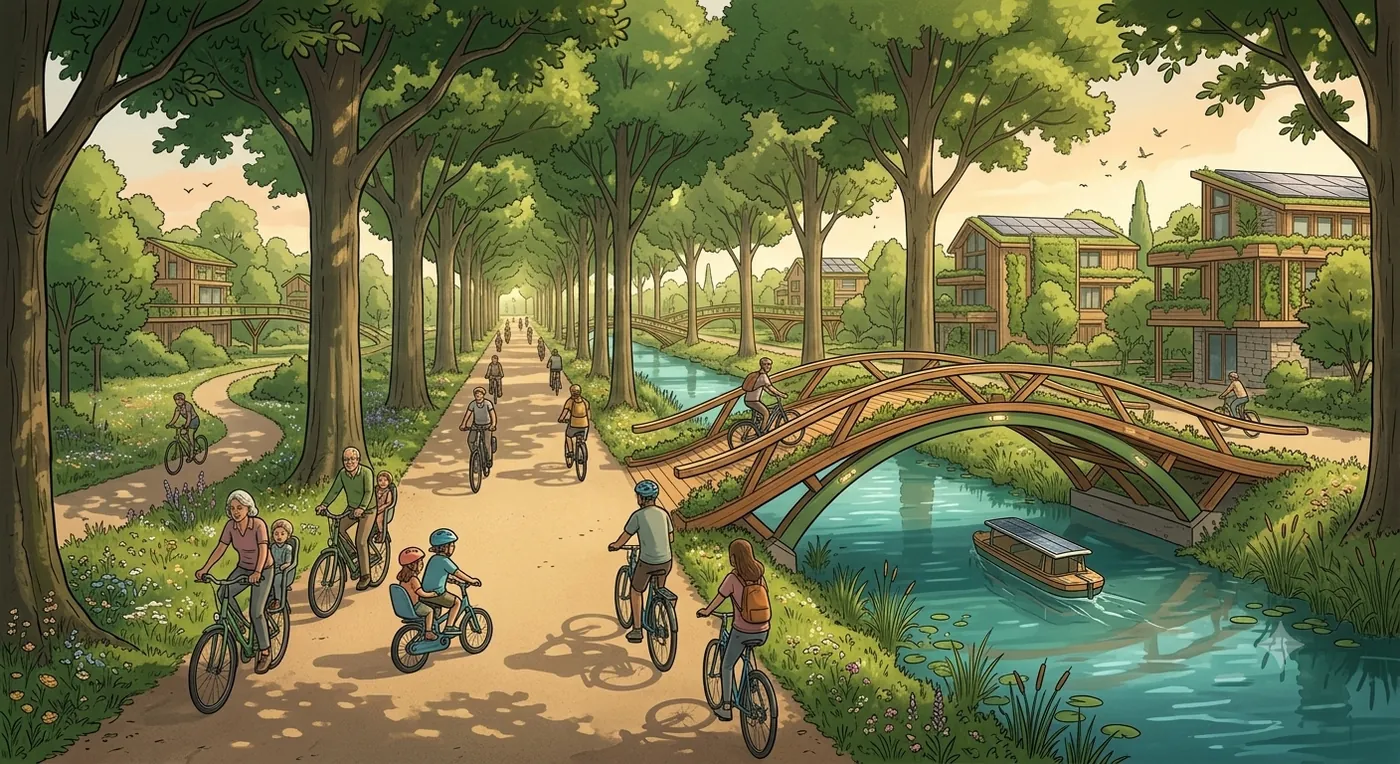
Wide, direct cycle route through greenery with its own bridge over a canal
Below ground

The ugly parts out of sight

Cars enter a tunnel before the city and pick their underground exit to the right hamlet. There they park in the hamlet hub, with a park on top and never more than 100 to 150 metres from your front door. Coming up to the door is possible, for moving house or loading, but otherwise the car stays below ground.

Because goods move too: groceries, parcels, waste, deliveries. They travel through the underground logistics network with hubs per district, so the delivery van never has to creep into the car-free streets. And visitors? They park in the outskirts and take the line into town. There they move like everyone else: walking, shared bike, pod.

Post & parcels

Collect whenever it suits you

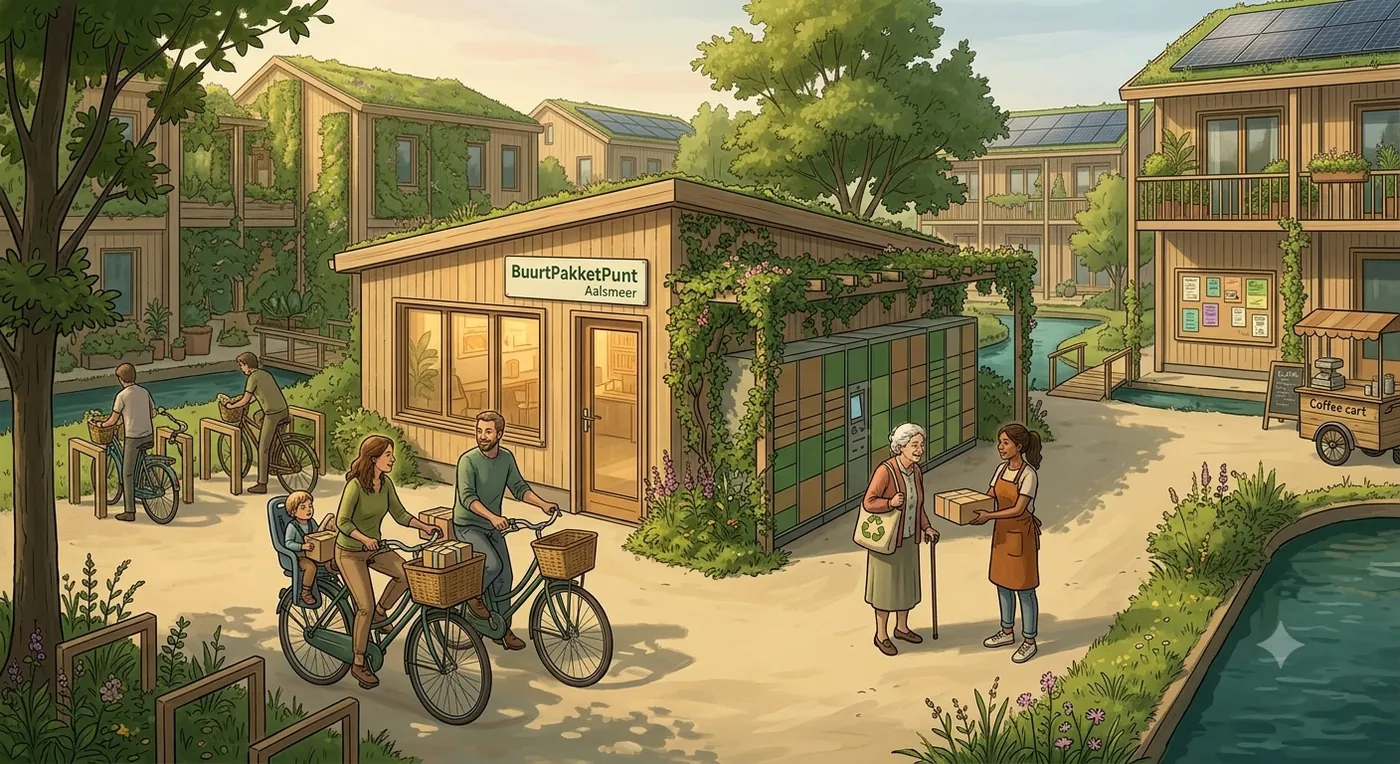
Door-to-door delivery is overloaded and was never meant for today's parcel flood. So the city turns it around: your parcel is delivered to a central point and you collect it whenever it suits you. No more waiting for a courier who never shows, and failed deliveries disappear entirely.

That takes enormous pressure off transport, because the last mile becomes one bulk run to a district hub instead of hundreds of vans along the doors. In the centre the post office returns as a real, social place. In the districts you find parcel lockers or pick up at the supermarket, a short walk or ride away.

Neighbourhood pickup point on a car-free square with parcel lockers and people collecting packages

Large items are still delivered. And whoever cannot collect, the elderly and the less mobile, gets home delivery from neighbourhood volunteers who want to do something for their area, as effort that earns credits. The same volunteer who brings the parcel has a quick chat and notices when someone is not doing well. Delivery doubles as a moment of contact against loneliness.

Emergency services

A city without traffic jams is the fastest for help

What looks like a weakness of a car-free city turns out to be an advantage: there is nothing to fight your way through. You only have to design the access in. Small posts per district keep every distance short. The promenades and the underground layer are built to carry a fire engine. And in a city full of canals, some of your ambulances simply sail, the way Venice runs ambulance boats.

That is how you move through the city.

But who does the city actually belong to? And how do you earn a nice place in it? That is the heart of the story.

To Housing & credits